GOLD CAMP -
TROPICO MINE

NAME: Gold Camp - Tropico Mine
COUNTY: Kern
ROADS: 2WD
GRID #(see map): 3
CLIMATE: Warm winter, hot summer
BEST TIME TO VISIT:
Anytime.
COMMENTS: About 50 miles north of Los Angeles. Drive west from Rosamond for 3 miles on Rosamond Blvd.;then turn north and follow the signs a short distance to Tropico.
REMAINS: AMines, tailings, headframe and old buildings from other mining camps including the old Plamdale School.

It can be said that clay turned to gold in the case of Ezra Hamilton. Hamilton owned and operated a pottery company in Los Angeles during the late 1870s and needed better quality clay than the local soil produced. He obtained a sample that came from the hills bordering the north side of Antelope Valley some fifty miles or so from Los Angeles. It was exactly the quality Hamilton needed for his business. He bought the property from its owner and took out two additional mineral claims. During the early 1890s, the economy slowed down and Hamilton started to pan the clay soil on his hill. He discovered what turned out to be gold. So, Mr. Hamilton's interest turned from clay to gold. The property has undergone a number of different owners since Hamilton's find in 1896. Operations continued until 1956 when the mine was closed, no longer being profitable to operate. The Tropico Gold Camp is closed to visitors in summer due to extreme desert heat. There are, however, weekend mine tours the year around as the underground levels are always cool. Submitted by Henry Chenowith.

In 1878 Ezra Hamilton, an owner of the East Side Pottery Company of Los Angeles, was searching for the right kind of potter's clay to use to make sewer pipe for the growing community of Los Angeles. He found this site so valuable that he bought the hill from its owner, Dr. L.A. Crandall, in 1882. In 1894, Hamilton started panning gold out of the clay and what he found made him forget about the clay or his diminishing requests for his sewer pipes. By 1896 his gold operation, called the Lida Mine, was bustling. In 1908 Hamilton sold the Lida to the Tropico Mining and Milling Company, named because many of the investors lived in the community of Tropico. Clifford Burton, a native of Canada, who made his first strike at Panamint, and his brother Cecil started out as employees of the Tropico Company and ended up as the owners, and the mine eventually became known as Burton's Tropico Gold Mine. The company prosepered until World War I closed the mine in 1917. When President Roosevelt raised the price of gold from $20 to $35 per ounce in the 1930's, the mine reopened, but soon closed again with the passage of Law 208 in 1942, which prohibited minig all but strategic materials during World War II. The total amount of production lies somewhere between $6 and $8 million. In 1958 the Settle family began the project of reopening the site as a tourist attraction by bringing in structures from other mining camps and nearby towns. These buildings were placed at the foot of the southern slope of Tropico Hill. Unfortunatley those buildings were auctioned off in 1982 and will soon be removed. Tours are given of the Tropico Mine which goes 900 feet down, with the remaining 600 feet of the shaft full of water. An additional piece of info. is in 1966, when during the county's 100th anniversary a shaft containing artifacts of the present were sealed as a time capusel to be opened only at the time of Kern County's 1,000th anniversary, in A.D. 2866. Submitted by: Nick Walrath


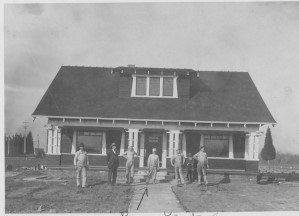
Tropico - The back says it was taken in 1908,  George Klentz and his painting crew with the owners of the house, freshly built, in Tropico.  Definitely a Christmas Card to his family in Kansas.
Courtesy Linda Kelly


1908 Christmas Card from Tropico
Courtesy Linda Kelly

 BACK